Saudization and Nitaqat Mutawar Program Explained: Everything Employers Need to Know
- What is Saudization?
- Why was the Saudization Program Introduced?
- Understanding the Nitaqat Program
- What is the Nitaqat Mutawar Program?
- How Does the Nitaqat System Work?
- Nitaqat Color Categories Explained
- What determines Saudization Percentage?
- How is Nitaqat Calculation Performed?
- Why Businesses should Monitor their Nitaqat Status
- Where can Employers Check their Nitaqat Status?
- Nitaqat Certificate: What is It and Why is It Important?
- How to Improve Your Nitaqat Status
- Common Saudization Compliance Challenges
- Industry-Specific Saudization Requirements
- Why Nitaqat Calculation is Critical for HR and Payroll Teams
- Best Practices for Saudization Compliance
- How Paylite Simplifies Saudization and Nitaqat Calculation
- Conclusion
- Frequently Asked Questions
Saudi Arabia’s Vision 2030 has brought significant changes to the country’s employment landscape. One of its most impactful workforce initiatives is Saudization, a national policy designed to increase the participation of Saudi citizens in the private sector. To ensure organizations actively contribute to this objective, the Ministry of Human Resources and Social Development (MHRSD) introduced the Enhanced Nitaqat Program, also known as the Nitaqat Mutawar Program.
Today, Saudization is more than a regulatory requirement. It has become a strategic workforce planning initiative that directly influences an organization’s ability to hire expatriates, renew work permits, access government services, and maintain business continuity. Every private-sector company in Saudi Arabia must understand how Nitaqat calculation works, how the Saudization percentage is determined, and how their Nitaqat status impacts day-to-day operations.
Unlike the earlier version of the program, the amended Nitaqat Mutawar Program uses a more dynamic methodology that evaluates businesses based on their economic activity, workforce size, occupational categories, and actual contribution toward employing Saudi nationals.
In this guide, we’ll explain everything employers need to know about Saudization, the Nitaqat Program, and how businesses can maintain healthy Nitaqat status.
What is Saudization?
Saudization, officially known as the Saudi Nationalization Program, is a government policy that encourages private-sector organizations to employ Saudi citizens across various industries and job categories.
The program aims to:
- Increase employment opportunities for Saudi nationals
- Reduce dependence on expatriate labor
- Develop local talent and skills
- Improve workforce sustainability
- Support Saudi Vision 2030 economic objectives
- Strengthen national participation in the private sector
The Ministry of Human Resources and Social Development (MHRSD) oversees the implementation of the Saudization program, while compliance is measured through the Nitaqat classification system.
Today, almost every private company operating in Saudi Arabia is subject to some level of Saudization requirements.
Why was the Saudization Program Introduced?
Historically, Saudi Arabia’s private sector relied heavily on expatriate workers. While this supported rapid economic growth, it also created challenges related to employment opportunities for Saudi nationals.
The Saudizationprogram was introduced to address these challenges by:
- Encouraging businesses to recruit Saudi citizens
- Creating long-term employment opportunities
- Building a skilled local workforce
- Reducing unemployment among Saudi nationals
- Supporting sustainable economic development
Rather than imposing identical hiring targets across all businesses, the government adopted a more flexible approach through the Nitaqat framework, allowing requirements to vary based on industry and company size.
Understanding the Nitaqat Program
Many employers hear the terms Saudization and Nitaqat used interchangeably, but they serve different purposes.
- Saudization is the national workforce localization policy.
- Nitaqat is the compliance framework used to measure how successfully organizations implement Saudization.
Introduced by MHRSD, the NitaqatProgram evaluates companies based on the percentage of Saudi nationals they employ relative to their workforce size and business activity.
The latest Nitaqat Mutawar Program goes beyond simple headcount calculations. It considers several workforce variables to provide a more accurate assessment of each employer’s compliance.
Organizations are classified into performance bands that determine the level of government services and incentives they can access.
What is the Nitaqat Mutawar Program?
The Nitaqat Mutawar Program is an enhanced version of the original Nitaqat framework introduced by the Ministry of Human Resources and Social Development.
The updated system was designed to:
- Better reflect differences across industries
- Encourage quality employment for Saudi nationals
- Improve fairness in workforce assessment
- Support labor market reforms under Vision 2030
- Promote sustainable localization instead of temporary hiring
Instead of applying a uniform Saudization percentage across all businesses, the Enhanced Nitaqat Program classifies organizations according to:
- Economic activity
- Number of employees
- Occupational categories
- Saudi employee participation
- Workforce composition
- Applicable localization targets
This approach allows the government to establish industry-specific Saudization benchmarks while recognizing that workforce requirements differ across sectors.
How Does the Nitaqat System Work?
Every eligible private-sector establishment receives a Nitaqat status based on its compliance with Saudization requirements.
This status determines whether the organization enjoys employment-related privileges or faces regulatory restrictions.
The classification is updated periodically as workforce data changes. Businesses should continuously monitor their Nitaqat status because changes in employee numbers, resignations, or new recruitment can directly affect compliance.
Nitaqat Color Categories Explained
One of the defining features of the Nitaqat Program is its color-based classification system.
Organizations are grouped into different compliance bands depending on their Saudization performance.
Platinum
Platinum is the highest compliance category.
Organizations in this category significantly exceed the required Saudization targets.
Benefits generally include:
- Faster government services
- Greater hiring flexibility
- Easier work permit processing
- Improved access to labor market services
- Strong employer reputation
Businesses achieving Platinum status demonstrate exceptional commitment to employing Saudi nationals.
High Green
High Green organizations comfortably meet or exceed the required Saudization percentage.
Employers in this category enjoy numerous operational advantages, including smoother government transactions and workforce management flexibility.
Medium Green
Organizations classified under Medium Green satisfy the minimum Saudization requirements while maintaining regulatory compliance.
Many employers aim to remain within the Green categories to avoid operational restrictions.
Low Green
Low Green companies remain compliant but operate close to the minimum localization threshold.
A reduction in Saudi employees or workforce changes could move these organizations into lower compliance categories.
Businesses in this category should actively monitor recruitment and retention strategies.
Red Category
Organizations that fail to meet the required Saudization percentage may fall into the Red category.
This classification can result in restrictions such as:
- Difficulty obtaining new work permits
- Limitations on recruiting expatriates
- Delays in government transactions
- Reduced labor market flexibility
Avoiding Red status is a major objective for HR and workforce planning teams.
What determines Saudization Percentage?
The Saudizationpercentage is one of the most important performance indicators under the Nitaqat Program.
Rather than simply counting Saudi employees, the calculation considers several workforce variables. These may include:
- Workforce Size: The total number of employees within your organization plays a significant role in determining your Nitaqat classification. Businesses are generally categorized into different size segments, such as micro, small, medium, large, and very large enterprises, with each category subject to specific localization requirements.
- Business Activity and Industry: Saudization targets vary across sectors to reflect the unique workforce demands of each industry. For instance, localization requirements in retail may differ considerably from those in sectors such as banking, financial services, healthcare, or technology, where higher Saudization percentages may be mandated.
- Profession-Specific Localization Requirements: Certain occupations are subject to dedicated Saudization regulations that may override the general company-level targets. Roles in fields such as accounting, engineering, human resources, and marketing often have prescribed localization percentages that organizations must meet regardless of their overall workforce composition.
- Salary Eligibility Criteria: Not every Saudi employee automatically contributes to an organization’s Saudization score. To be counted in Nitaqat calculations, Saudi nationals must receive a minimum monthly salary that meets the thresholds established by the Ministry of Human Resources and Social Development (MHRSD). These thresholds may vary depending on the profession and job category.
- Employee Registration and Documentation: For a Saudi employee to be recognized within the Nitaqat framework, they must be properly registered with the General Organization for Social Insurance (GOSI) and have a valid employment contract documented through the Qiwa platform. Incomplete registrations or missing documentation may affect the organization’s Saudization calculations.
- Special Workforce Weightings: The Nitaqat Program applies weighted values to certain categories of Saudi employees. For example, individuals with disabilities or eligible remote workers may contribute more significantly toward an organization’s Saudization percentage under specific conditions. However, the system includes controls and limits to ensure fair application and prevent overreliance on weighted categories.
Because these requirements evolve over time, organizations should regularly review official announcements and industry-specific guidelines.
How is Nitaqat Calculation Performed?
The Nitaqat Saudization percentage measures the proportion of Saudi nationals employed within an organization compared to its total workforce. It is determined by comparing the average number of Saudi employees against the combined average number of Saudi and expatriate employees, then converting the result into a percentage.
The resulting percentage plays a critical role in determining an organization’s Nitaqat classification (Platinum, Green, or Red categories), which directly impacts its ability to recruit expatriate workers, obtain work visas, and access various government services.
Nitaqat Calculation Formula

Where:

Important Considerations for Nitaqat Calculation
Qiwa Contract Registration
A Saudi employee will only be included in the Saudization calculation if their employment contract is properly documented through the Qiwa platform and their employment details are registered with the General Organization for Social Insurance (GOSI). Failure to complete these registrations may prevent the employee from being counted toward the organization’s Saudization targets.
Workforce Data Accuracy
Maintaining accurate employee records across Qiwa, GOSI, and payroll systems is essential to ensure correct Nitaqat calculations and avoid discrepancies that could negatively affect the organization’s Nitaqat status.
Continuous Monitoring
Since workforce numbers change due to hiring, resignations, transfers, and terminations, businesses should regularly monitor their Saudization percentage to maintain compliance and avoid falling into lower Nitaqat categories.
Understanding the Nitaqat Calculator
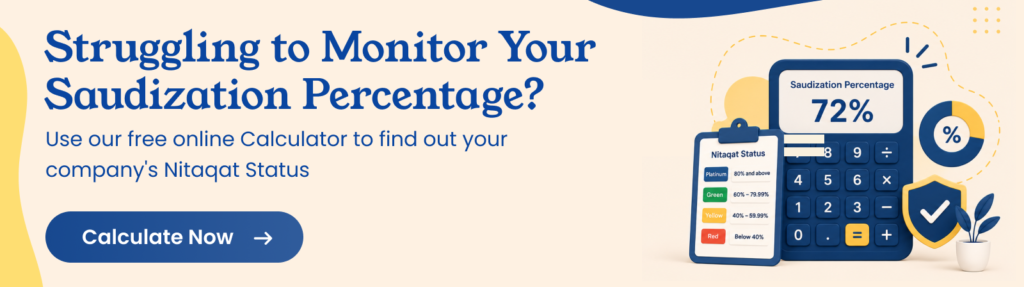
To help employers monitor compliance, HR professionals use our free Nitaqat calculator online.
A Nitaqat calculator estimates an organization’s Saudization percentage by analyzing workforce data against the applicable localization requirements.
Although calculation methods vary depending on industry and workforce composition, a typical Nitaqat calculator requires information such as:
- Company activity
- Number of Saudi employees
- Number of expatriate employees
- Workforce size
- Employee categories
The calculator then estimates the organization’s likely Nitaqat classification.
While unofficial online calculators can provide estimates, employers should always rely on official MHRSD requirements and their workforce records when making compliance decisions.
Why Businesses should Monitor their Nitaqat Status
Your Nitaqat status directly impacts your organization’s ability to operate efficiently in Saudi Arabia.
Maintaining a healthy status helps businesses:
- Recruit skilled expatriate talent when permitted
- Renew work permits without delays
- Expand workforce planning
- Improve government service accessibility
- Enhance employer credibility
- Reduce compliance risks
Conversely, falling below the required Saudization percentage may restrict hiring activities and increase administrative challenges.
For this reason, HR teams should monitor workforce composition throughout the year rather than waiting for periodic compliance reviews.
Where can Employers Check their Nitaqat Status?
Employers frequently search for the Nitaqat website to verify their compliance status and access official labor market services.
The Ministry of Human Resources and Social Development provides digital services through its official online platforms, where eligible businesses can review workforce information, compliance records, and localization-related services. In addition, many organizations use the Qiwa platform, which integrates several employment and labor services, including information relevant to Saudization compliance and workforce management.
Since workforce data changes continuously due to recruitment, resignations, transfers, and employee lifecycle events, businesses should regularly monitor their records to ensure their reported information remains accurate.
Nitaqat Certificate: What is It and Why is It Important?
A Nitaqat certificate is an official document that confirms an organization’s current classification under the Nitaqat (Saudization) Program. It reflects the company’s compliance with the required Saudization targets established by the Ministry of Human Resources and Social Development (HRSD).
Businesses may require a Nitaqat certificate for various administrative and regulatory purposes, including participation in government tenders, compliance reviews, and internal workforce planning. It also serves as proof that the organization meets the applicable localization requirements for its industry.
Maintaining an updated Nitaqat certificate demonstrates an employer’s commitment to workforce nationalization and regulatory compliance.
How to Improve Your Nitaqat Status
Maintaining a favorable Nitaqat status requires continuous workforce planning rather than periodic compliance checks. Organizations that actively monitor their Saudization performance are better positioned to remain compliant and avoid operational disruptions.
Here are several practical strategies to improve your Nitaqat status:
Recruit Qualified Saudi Nationals
Hiring skilled Saudi professionals in eligible roles is the most effective way to improve the organization’s Saudization percentage.
Invest in Employee Development
Providing training, career progression opportunities, and professional development programs helps retain Saudi employees and reduces turnover.
Monitor Workforce Composition Regularly
Changes in employee headcount due to resignations, retirements, or new hires can impact your Nitaqat classification. Regular reviews help identify compliance risks early.
Maintain Accurate Employee Records
Ensure all employee information, contracts, salary details, and registrations are updated across payroll and HR systems.
Plan Recruitment Strategically
Align recruitment plans with the organization’s Saudization targets to maintain the required balance between Saudi nationals and expatriate employees.
Use HR Technology
Automated HR and payroll systems provide real-time workforce analytics, making it easier to monitor Saudization percentages and predict changes to your Nitaqat classification.
Common Saudization Compliance Challenges
While the Saudization Program has created significant employment opportunities for Saudi nationals, many businesses face practical challenges in maintaining compliance.
Some of the most common challenges include:
Workforce Planning
Balancing operational requirements with localization targets can be difficult, particularly in specialized industries where qualified local talent may be limited.
High Employee Turnover
Unexpected resignations of Saudi employees may reduce the organization’s Saudization percentage and affect its Nitaqat status.
Manual Calculations
Tracking workforce composition manually using spreadsheets increases the likelihood of errors and outdated information.
Regulatory Updates
Saudization requirements continue to evolve across different industries. HR teams must stay informed about sector-specific localization initiatives and revised compliance thresholds.
Multiple Business Units
Organizations operating across several branches or legal entities often face additional complexity when monitoring workforce compliance across locations.
Industry-Specific Saudization Requirements
One of the key features of the Nitaqat Mutawar Program is that Saudization requirements vary by industry. Rather than applying a uniform target to every business, MHRSD establishes localization percentages based on economic activity and labor market needs.
Several industries have dedicated Saudization initiatives, including:
- Retail
- Banking and Financial Services
- Healthcare
- Engineering
- Information Technology
- Hospitality and Tourism
- Logistics and Transportation
- Telecommunications
- Accounting and Finance
- Real Estate
These sector-specific programs may include minimum localization percentages for certain professions, making it essential for employers to monitor the latest MHRSD regulations applicable to their business activity.
Why Nitaqat Calculation is Critical for HR and Payroll Teams
HR and payroll departments play a central role in ensuring Saudization compliance. Every hiring decision, salary update, employee transfer, or termination can influence an organization’s workforce composition and Nitaqat calculation.
An inaccurate workforce record may lead to:
- Incorrect Saudization percentage calculations
- Delays in work permit processing
- Compliance risks during government audits
- Administrative penalties
- Difficulty recruiting expatriate employees
Modern HRMS platforms help organizations eliminate these risks by providing centralized employee records and automated workforce reporting.
Best Practices for Saudization Compliance
Organizations can strengthen compliance with the Saudization Program by adopting the following best practices:
Conduct Regular Workforce Audits
Review workforce composition periodically to identify potential compliance gaps before they affect your Nitaqat classification.
Keep Employee Records Up to Date
Ensure employee nationality, employment status, job titles, and salary information remain accurate in HR and payroll systems.
Monitor Regulatory Changes
Stay informed about updates issued by MHRSD, especially those affecting industry-specific Saudization requirements.
Coordinate HR and Payroll Processes
Integrating HR and payroll systems ensures employee data remains consistent across recruitment, payroll, attendance, and statutory reporting.
Forecast Workforce Changes
Anticipate the impact of planned recruitment, resignations, retirements, and internal transfers on your Saudization percentage.
How Paylite Simplifies Saudization and Nitaqat Calculation
Managing Saudization, monitoring Nitaqat status, and ensuring workforce compliance can become increasingly complex as organizations expand. Manual calculations, disconnected systems, and frequent regulatory updates often increase the administrative burden on HR teams.
Paylite provides an integrated HRMS and payroll platform designed to help organizations automate workforce management while supporting compliance with Saudi labor regulations.
Automated Nitaqat Calculation
Paylite enables HR teams to monitor workforce composition and calculate Saudization percentages using centralized employee data. Automated reporting helps organizations evaluate their compliance position more efficiently.
Real-Time Workforce Visibility
HR managers can access dashboards that provide insights into:
- Saudi and expatriate employee ratios
- Workforce demographics
- Department-wise employee distribution
- Recruitment trends
- Employee lifecycle changes
This visibility allows organizations to proactively manage their Nitaqat status.
Integrated HR and Payroll
Paylite connects core HR, payroll, attendance, recruitment, onboarding, leave management, and employee self-service into a single platform. This ensures that employee data remains synchronized across all HR processes.
Compliance-Focused Reporting
Generate comprehensive reports to support workforce planning, regulatory reporting, payroll audits, and management decision-making.
Recruitment and Onboarding
Paylite streamlines the recruitment and onboarding process, enabling organizations to efficiently hire and retain qualified Saudi nationals while supporting localization goals.
Employee Lifecycle Management
From recruitment and onboarding to promotions, transfers, payroll, performance management, and end-of-service settlements, Paylite manages every stage of the employee lifecycle through a unified platform.
Scalable for Growing Businesses
Whether your organization has 50 employees or several thousand, Paylite provides the scalability needed to manage evolving workforce requirements while supporting Saudization compliance.
By automating workforce management, Paylite helps organizations reduce manual effort, improve data accuracy, and make informed decisions that support long-term compliance with the Saudization Program.
Conclusion
Saudization continues to play a vital role in shaping Saudi Arabia’s private-sector workforce. Through the Nitaqat Mutawar Program, the government has established a transparent framework that encourages businesses to employ Saudi nationals while supporting KSA’s Vision 2030 objectives.
Understanding Nitaqat calculation, maintaining the required Saudization percentage, and regularly monitoring your Nitaqat status are essential for ensuring uninterrupted business operations. As Saudization policies continue to evolve, businesses need more than spreadsheets and manual tracking. An integrated HR and payroll solution like Paylite empowers organizations to automate workforce management, streamline compliance processes, and make data-driven decisions that support sustainable growth in Saudi Arabia.
Frequently Asked Questions
Saudization is a national workforce localization initiative introduced by the Saudi government to increase the employment of Saudi nationals in the private sector. It forms a key part of Saudi Vision 2030 and is implemented through the Nitaqat Program.
The Nitaqat Program is a compliance framework developed by the Ministry of Human Resources and Social Development (MHRSD) to measure an organization’s Saudization performance. Companies are classified into different categories based on their employment of Saudi nationals.
To check your company’s Nitaqat status, visit the official MHRSD online inquiry service. Select your preferred identification method, Iqama Number, Border Number, or Passport Number. Enter the required information, verify the security code, and submit your request. The system will display your employer’s current Nitaqat classification.
You can also log in to the Qiwa portal through your Absher account to access detailed employment information, including your company’s latest Nitaqat status and Saudization compliance records.
A Nitaqat certificate is an official document confirming a company’s current Nitaqat classification and Saudization compliance. It may be required for government transactions, tenders, and regulatory verification.
Organizations in the Red category may face restrictions on government services, difficulties in obtaining or renewing work permits for expatriates, and other administrative limitations until they improve their Saudization performance.
Accurate Nitaqat calculation helps organizations monitor their Saudization compliance, avoid penalties, maintain access to government services, and support strategic workforce planning.
Modern HR and payroll software automates workforce tracking, employee record management, reporting, and compliance monitoring. Solutions like Paylite enable organizations to monitor Saudization percentages, streamline Nitaqat calculation, and maintain accurate workforce data for regulatory compliance.